ADVERTISEMENT
I Thought Waking Up at 3:17 AM and Watching My Clothes Get Tighter Were Two Separate Problems
By Claire M. | Health & Wellness
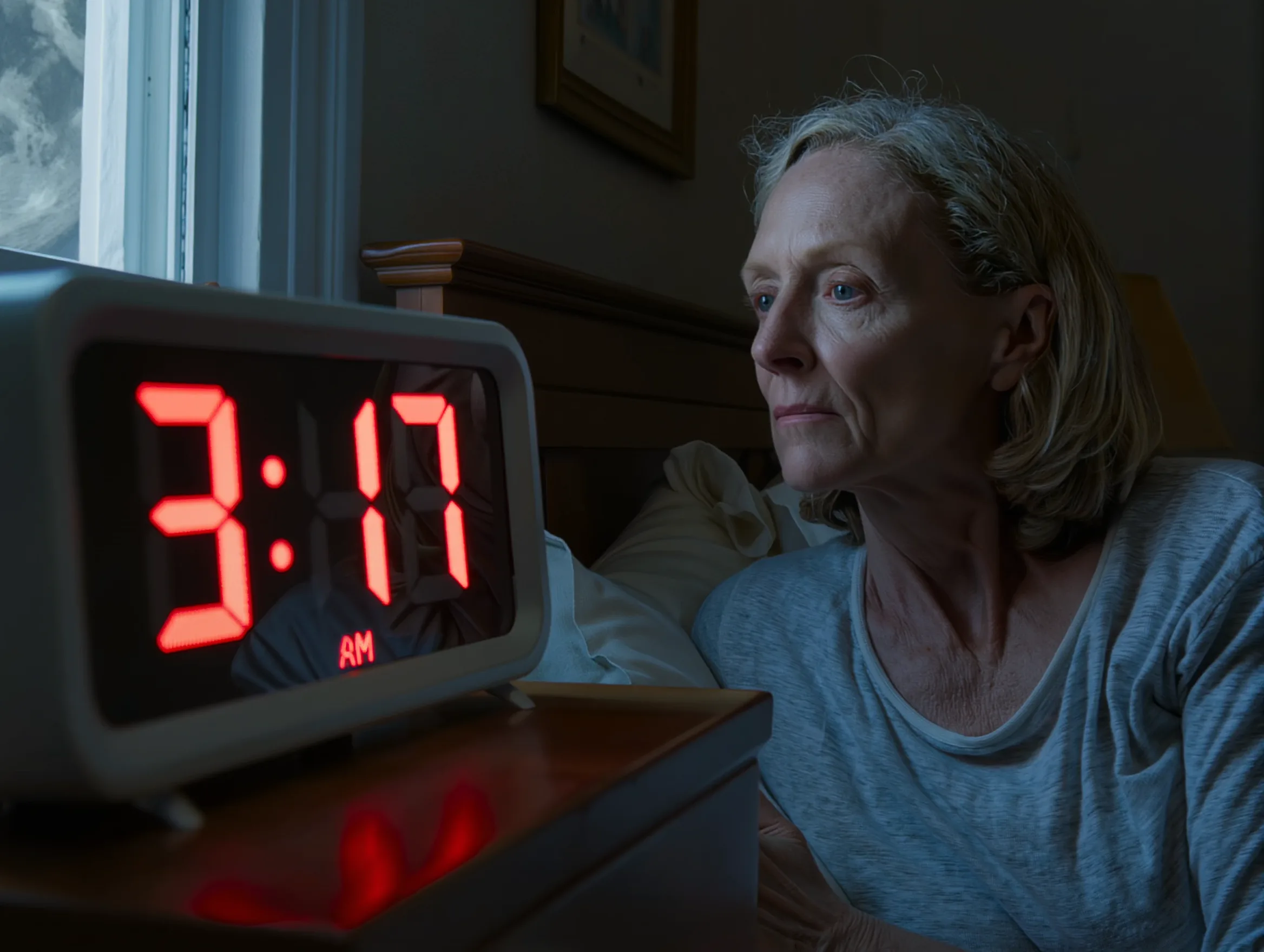
I was 52 years old. I couldn’t remember the last time I had slept through an entire night… Maybe two years. Maybe three.
After menopause, everything changed…
Falling asleep became a struggle.
I would lie there staring at the ceiling. One hour passed. Then two… And nothing.
My body was completely exhausted.
But my mind was wide awake and racing.
Jumping from one worry to another… replaying everything I had forgotten to do.
And when exhaustion finally became unbearable and I drifted off…
I would suddenly wake up with my heart pounding.
I would turn toward the clock:
3:17 AM.
I would take a deep breath and stare at that same ceiling again.
Every passing minute felt like torture.
The anxiety made it impossible to fall back asleep.
And I already knew what was waiting for me the next morning:
Another zombie day.
Exhausted and desperate for answers, I spent countless early mornings searching Google.
I became convinced that I had insomnia.
So I did what almost everyone does.
I assumed it must be a melatonin problem.
That same night, I drove to the pharmacy and bought a bottle.
I started with 3 mg.
At first, I thought it was helping…
But before long, it stopped working.
So I increased it to 5 mg…
Then 10 mg.
The dose kept increasing, but the same exhausting cycle always returned.
And here’s what no one had warned me about.
The higher the dose became, the worse I felt the following morning.
I would wake up so groggy and exhausted that simply getting out of bed felt like work.
My husband would speak to me over breakfast.
I could hear his voice…
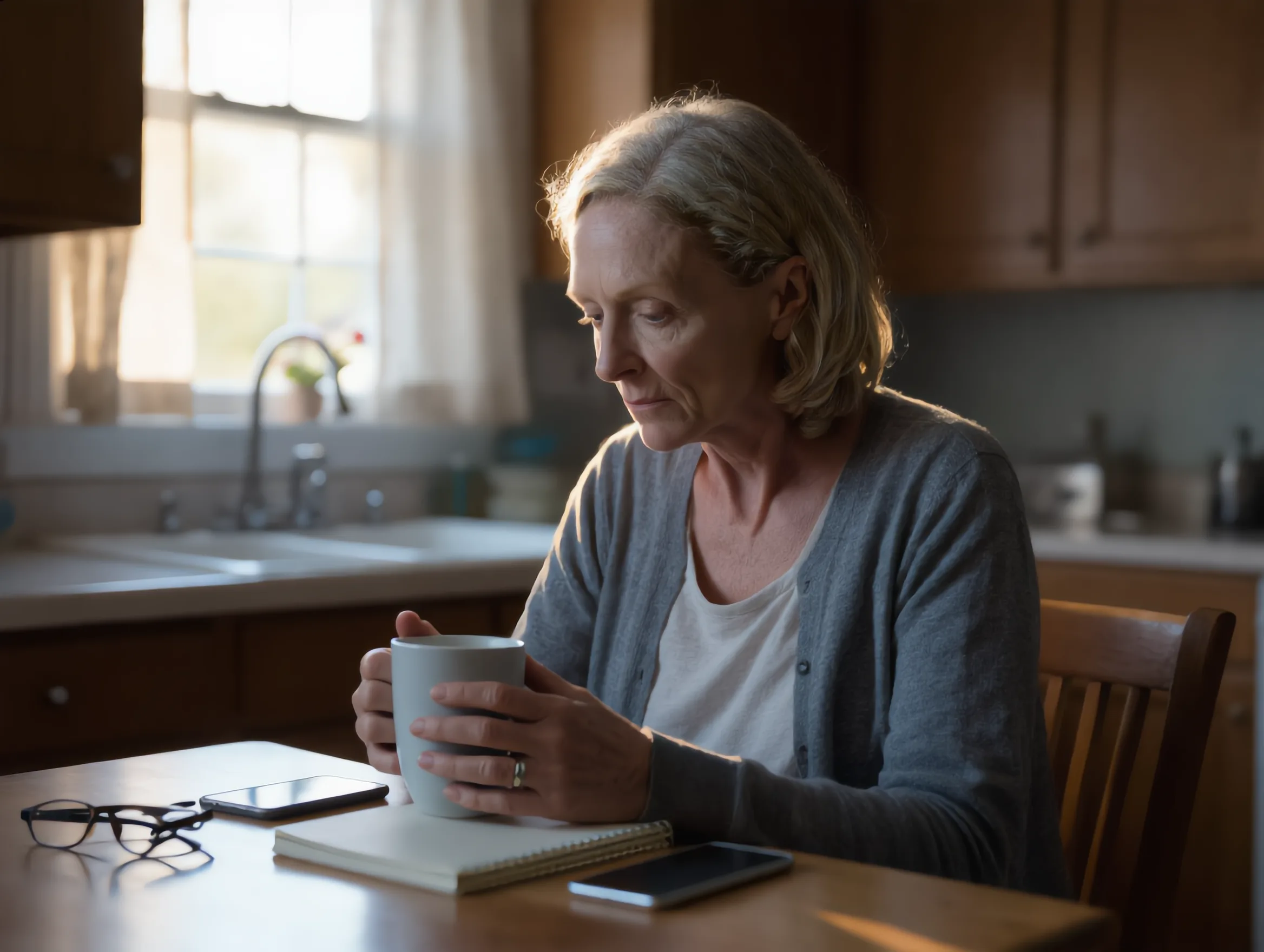
But I would just stare into my coffee, struggling to put a sentence together.
By ten in the morning, I already needed another cup.
After lunch, my body begged for sugar.
Anything that might give me enough energy to survive the rest of the day.
I was too tired to take a walk.
Too tired to prepare a decent meal.
And little by little, my clothes started feeling tighter.
Just one more thing I blamed on menopause.
My brain felt wrapped in a heavy fog.
I became distracted.
Forgetful.
Irritable.
And the worst part?
I eventually started waking up in the middle of the night again.
The melatonin was making my mornings worse…
Without fixing my nights.
So, after talking it over with my husband, I decided to stop taking it.
And everything fell apart.
That same ceiling.
Those same endless minutes in the middle of the night.
That same exhausting cycle beginning all over again.
As evening approached, I could already feel the knot forming in my stomach.
Another night of fighting to sleep.
Completely alone with my thoughts.
Then one afternoon after Pilates, I finally told a friend what had been happening.
Three years without knowing what a full night of sleep felt like.
She listened quietly.
Then she smiled and mentioned something she called…
“The 30-second cherry trick.”
I nearly rolled my eyes.
I had already tried everything.
But as she continued explaining it…
I realized I was exhausted — and desperate enough to try one more thing.
So that same evening, shortly before bed, I tried it for the first time.
I still don’t know how to describe what happened next.
It felt as though someone had gently turned down the noise inside my head.
My husband looked at me curiously as I walked toward the bedroom.
I lay down beneath that same ceiling…
But this time, my mind felt different.
Quiet.
Slower.
Calm.
And I simply fell asleep.
When I opened my eyes again, something felt wrong.
The room wasn’t dark.
Soft morning light was coming through the window.
I reached for my phone.
6:53 AM.
For a moment, I just stared at the screen.
I had slept through the entire night.
No sudden 3:17 wake-up.
No staring at the ceiling.
No checking the clock.
No knot in my stomach.
I had simply slept.
Gone.
The anxious hours staring at the ceiling?Gone.
That knot in my stomach every evening?Gone.
The zombie days slowly became a memory. I hadn’t felt that kind of energy in years. My friend from Pilates noticed the difference almost immediately. “You tried the cherry trick, didn’t you?” she asked with a big smile. She was right. My mood had returned. My focus felt sharper. My memory felt clearer. And one morning, my husband looked at me and said:“I finally feel like I have my wife back.”
Then, around the sixth week, something happened that I wasn’t expecting.
My husband and I were getting ready to celebrate our anniversary.
I reached for a pair of pants I loved but had avoided wearing because they had become painfully tight around my waist.
I slipped them on.
Buttoned them.
And looked down.
They were loose.
I stood in front of the mirror, trying to understand.
I tried on another pair.
The same thing.
Then I reached for a dress I had worn to my nephew’s graduation two years earlier.
It felt loose too.
And I hadn’t started a diet.
I hadn’t joined a weight-loss program.
I wasn’t even trying to lose weight.
Or at least… that was what I thought.
Because when I stopped to think about it, small things had changed.
My cravings for sugar had become less intense.
I no longer spent the entire day searching for something that would give me energy.
I had started walking again.
I was preparing real meals again.
I was taking care of myself again.
None of it had been planned.
I simply had energy again.
Sleeping better was one thing.
But somehow, better nights seemed to be changing my days too.
And that made me curious enough to speak with my doctor.
I told him about waking up at 3:17 every morning.
About the exhaustion.
About feeling hungrier after especially bad nights.
And about the small changes I had started noticing after I began sleeping through the night again.
He remained silent for a few seconds.
Then he said:
“Claire, those things may be far more connected than you realize.”
I leaned forward.
“What do you mean?”
He explained that repeatedly interrupted sleep doesn’t only affect how we feel the following morning.
It may also interfere with some of the signals involved in energy, hunger, blood-sugar regulation, and the way our bodies respond to food.
Then he mentioned something I had heard about in advertisements but had never connected to sleep:
GLP-1.
“Is that the same GLP-1 people talk about with Ozempic?” I asked.
“The natural hormone is part of the same biological system,” he replied.
“But I’m not saying that sleeping works like a medication.”
He paused.
“What I’m saying is that sleep, appetite, energy, and metabolism are not necessarily separate problems.”
As I listened, I thought about that conversation after Pilates.
About the cherry.
About the nights when I had finally started sleeping again.
And about everything that had slowly begun changing during the day.
For the first time, it all seemed like part of the same story.
As soon as I got home, I called my friend.
“I need to understand what you showed me.”
She sent me a presentation explaining the complete connection.
And what I discovered changed the way I looked at my nights forever.
For three years, I had treated my broken sleep as just another consequence of getting older.
Three years trying to solve it with melatonin.
Three years living like a zombie.
Three years staring at the same ceiling at 3:17 in the morning.
Until one conversation after Pilates changed the way I saw everything.
So if you can fall asleep…
But keep waking up in the middle of the night with a mind that refuses to slow down…
I simply want you to look into this discovery.
That’s all.
Because three years from now…
I don’t want you to still be staring at the ceiling at three in the morning, wondering why nothing has worked.
Tap the button below to watch the same presentation my friend shared with me.
Sweet dreams,
Claire
Affiliate Disclosure: This website contains affiliate links. If you purchase through one of these links, we may receive a commission at no additional cost to you.
Health Disclaimer: The information presented on this page is for educational and informational purposes only and is not intended to diagnose, treat, cure, or prevent any disease. It is not a substitute for professional medical advice. Individual experiences and results may vary.
Claire is a fictional composite created to illustrate experiences commonly reported by adults with disrupted sleep. The illustrative images on this page were created using artificial intelligence.
Privacy Policy | Terms & Conditions | Contact
© 2026 Health Path Discover. All rights reserved.
Illustrative image. Claire is a fictional composite created to represent common experiences shared by adults struggling with disrupted sleep.